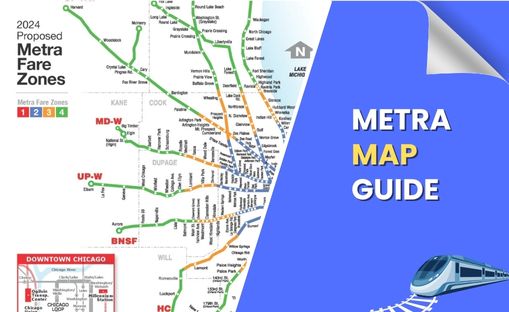
Finding convenient parking is an important part of planning a Metra trip, especially for commuters who drive to their station before boarding the train. Metra parking is available at most stations, with options that can include daily-fee parking and monthly permits. However, parking arrangements vary by station because Metra does not manage parking at most locations.
In many communities, the local municipality or its parking vendor operates the lot and determines the applicable parking rules, fees, permits, payment methods, and enforcement procedures. Some parking facilities are operated by SP+ Parking or other vendors.
This guide explains how Metra station parking works, how to check parking information for your station, what to know about daily and monthly parking, and how to avoid common parking problems.
Metra Parking at a Glance
| Parking Feature | What Riders Should Know |
|---|---|
| Parking availability | Available at most Metra stations |
| Daily parking | Offered at many stations |
| Monthly parking | Available at many stations |
| Parking operator | Usually the municipality or its parking vendor |
| Metra’s role | Metra does not manage parking at most stations |
| Private/vendor parking | SP+ operates parking at select locations |
| Fees | Vary by station and parking operator |
| Parking rules | Depend on the individual station and municipality |
| Payment methods | Vary by parking facility |
| Permit parking | Available at selected stations |
| Accessible parking | Available according to applicable station and ADA arrangements |
| Best source for local rules | The station’s official information and parking operator |
Metra’s rider information confirms that monthly permits and daily-fee parking are available at most stations, but the municipality generally manages the parking facility rather than Metra itself.
Does Metra Have Parking at Its Stations?
Yes. Parking is available at most Metra train stations, making it possible for many suburban commuters to drive to a station, park their vehicle and continue their trip by rail.
However, it is important to understand that Metra parking does not operate under one universal system.
Each community can have its own:
- Parking fees
- Daily parking rates
- Monthly permit requirements
- Parking hours
- Payment methods
- Permit application procedures
- Enforcement rules
- Overnight parking restrictions
- Snow or weather-related restrictions
- Reserved or permit-only spaces
Because of these differences, riders should check the parking information for their specific Metra station before traveling.
Who Manages Metra Station Parking?
One of the most important things to know about Metra parking is that Metra does not manage parking at most stations.
The municipality where a station is located generally manages its parking lots. The municipality may operate the lot itself or use a parking contractor.
At select locations, parking facilities are operated by SP+ Parking, which provides daily and monthly parking options.
This means that the parking rules at one Metra station may be different from those at another station—even if both stations are on the same rail line.
Why Parking Rules Differ by Station
Local parking authorities may determine:
- How much parking costs
- Whether parking is free
- Whether a permit is required
- Where permits can be purchased
- Which spaces are reserved
- Whether overnight parking is allowed
- How parking violations are handled
- What payment methods are accepted
Therefore, never assume that the parking rules at your usual station apply to another Metra station.
Daily Metra Parking
Daily parking is designed for riders who do not need a long-term parking permit.
Many Metra stations offer daily-fee parking, although the exact price and payment process depend on the individual parking facility.
Daily parking can be particularly useful for:
- Occasional commuters
- Hybrid workers
- Weekend travelers
- Visitors using Metra
- Riders making occasional trips into Chicago
- People testing a station before becoming regular commuters
Metra’s parking design guidelines identify daily-fee collection as a preferred parking-control approach because it can allow parking spaces to be used by a broader range of riders.
How Daily Parking Works
The process depends on the station. A parking facility may use:
- A parking meter
- A coin box
- Electronic payment
- A mobile payment system
- Another system operated by the municipality or parking vendor
Metra’s design guidelines specifically recognize electronic payment systems and mobile applications as part of modern parking operations.
Always look for posted instructions when you arrive.
Metra Monthly Parking Permits
Monthly parking can be useful for riders who regularly drive to the same station.
A monthly permit may allow a commuter to use a designated parking facility throughout the applicable permit period. However, availability, pricing, eligibility, and permit rules are station-specific.
Before purchasing a monthly permit, check:
- Monthly parking price
- Permit availability
- Permit application requirements
- Whether spaces are reserved
- Permit expiration date
- Renewal process
- Where the permit is valid
- Rules for displaying the permit
- Restrictions on overnight parking
Metra’s parking guidelines recognize monthly permits as one parking-control method, while noting that daily-fee systems can make more efficient use of spaces when riders do not commute every day.
How Much Does Metra Parking Cost?
There is no single Metra-wide parking price that applies to every station.
Parking rates can vary considerably because the municipality or parking operator generally controls the facility.
Your parking cost may depend on:
- Station location
- Parking lot
- Daily vs. monthly parking
- Permit type
- Parking operator
- Reserved vs. general parking
- Local municipal rules
For this reason, avoid relying on an old parking price found on another website. Check the current information for your specific station before leaving home.
Metra Parking Cost: What to Check
| Parking Question | Why It Matters |
|---|---|
| Is parking free? | Some facilities may have different arrangements |
| What is the daily fee? | Helps calculate your commuting cost |
| Is monthly parking available? | Useful for frequent riders |
| Is a permit required? | Some lots have controlled parking |
| What payment methods are accepted? | Prevents payment problems |
| Is parking available overnight? | Important for long trips |
| Are weekends different? | Rules may vary |
| Is the lot operated by a vendor? | The vendor may handle payments and enforcement |
Is Metra Parking Free?
Some Metra stations or nearby parking facilities may offer free parking, but you should not assume that parking is free simply because a station is outside Chicago.
Parking conditions vary by municipality and individual facility.
A station can have:
- Free parking
- Paid daily parking
- Monthly permit parking
- A combination of parking types
- Municipal parking
- Vendor-operated parking
- Nearby private parking
Always check the signs and official station information before leaving your vehicle.
Where Can I Find Parking Information for My Metra Station?
The most reliable approach is to look up your specific Metra station.
Metra’s rider information advises customers to use the phone number listed on the station page for station-specific parking information.
When researching your station, look for:
- Parking availability
- Parking lot location
- Daily rate
- Monthly permit information
- Parking operator
- Payment instructions
- Contact information
- Parking restrictions
- Accessible parking information
This is especially important when traveling to an unfamiliar station.
Metra Parking by Station
Because parking is locally managed at many stations, there is no single parking policy covering every location.
Popular stations can have different arrangements based on their location and parking operator.
For example, a commuter should check the individual station information before driving to locations such as:
- Naperville
- Arlington Heights
- Hinsdale
- LaGrange
- Elmhurst
- Downers Grove
- Glenview
- Evanston
- Oak Park
- Homewood
- Tinley Park
- Aurora
- Schaumburg-area stations
The availability and cost of parking can change independently from Metra train fares and schedules.
Metra Parking in Chicago
Parking works differently at downtown Chicago destinations because many riders arrive from suburban stations rather than driving directly to the terminal.
For riders who want to park near a downtown Metra destination, available parking may be provided through:
- Municipal parking facilities
- Private garages
- Commercial parking operators
- Street parking
- Other nearby parking facilities
If you are driving into Chicago rather than parking at a suburban Metra station, compare the total parking cost with the cost and convenience of parking at your origin station and taking the train.
Metra Parking Payment Options
Payment methods depend on the parking operator.
A station may accept one or more of the following:
- Cash
- Coins
- Credit or debit cards
- Mobile payments
- Parking apps
- Permit-based payment
Metra’s station and parking design guidelines describe several possible fee-collection systems, including parking meters, coin boxes and electronic payment systems.
Before You Park
Check the parking signs for:
- Required payment amount
- Payment location
- Accepted payment methods
- Permit requirements
- Time restrictions
- Space restrictions
- Enforcement hours
Taking a photo of the parking instructions can also be useful if you are visiting an unfamiliar station.
Metra Parking Permits
A parking permit may be required at certain facilities.
Depending on the station, a permit can be:
- Monthly
- Facility-specific
- Reserved
- Permit-only
- Subject to availability
Do not park in a permit-only space unless your vehicle meets the posted requirements.
Metra’s station signage specifications include dedicated signs for permit parking, permit-only spaces, daily-fee parking and commuter parking, reflecting the different parking arrangements riders may encounter.
Metra Parking for Commuters
For daily commuters, parking is an important part of the overall transportation cost.
Consider the following when choosing a station:
1. Daily parking price
Calculate how much you would spend over an average month.
2. Monthly permit availability
A monthly permit may be convenient if you regularly use the same station.
3. Parking capacity
A low-cost lot is not useful if it regularly fills before your arrival time.
4. Distance from parking to platform
A nearby lot can make your morning routine easier.
5. Security and lighting
Look for well-maintained facilities and follow the parking operator’s safety guidance.
6. Alternative transportation
Compare driving to the station with local bus, rideshare, walking or biking options.
How Early Should You Arrive to Park?
If you need to park before catching a Metra train, give yourself additional time.
Metra advises new riders to arrive at the station early enough to park and purchase a ticket before boarding.
Your parking time should account for:
- Finding a space
- Walking from the lot to the platform
- Paying for parking
- Buying or activating your train ticket
- Checking the departure board
- Reaching the correct platform
During busy weekday periods, parking lots can fill faster than expected.
Metra Parking and Train Departure Times
Remember that Metra timetable times are departure times from the station, not arrival times.
If your train is scheduled to leave at 7:30 a.m., do not plan to arrive in the parking lot at 7:29 a.m.
Instead, allow enough time to:
Drive → Park → Pay → Walk → Find Platform → Board Train
This is particularly important at larger stations where parking areas can be some distance from the platform.
Accessible Parking at Metra Stations
Accessible parking is an important part of station planning for passengers with disabilities.
Metra’s parking design guidelines address accessible parking spaces and require parking fee collection systems serving ADA spaces to be usable by people with disabilities.
Before traveling, riders who need accessible parking should check the accessibility information for both their origin and destination stations.
If you require specific assistance, checking ahead of time is recommended.
Metra Parking During Winter
Winter weather can affect parking conditions even when train service continues.
Snow and freezing temperatures can create challenges such as:
- Snow-covered parking spaces
- Icy walking paths
- Reduced visibility
- Temporary parking restrictions
- Snow removal operations
- Slippery sidewalks
- Changes to available spaces
Metra’s parking design guidelines specifically address snowplowing, maintenance operations and winter protection for parking equipment.
During severe winter weather, check both parking information and Metra service alerts before traveling.
Metra Parking and Service Alerts
Parking problems and train-service problems are separate issues.
A train may be running normally while parking availability is affected by:
- Construction
- Lot repairs
- Local events
- Snow removal
- Maintenance
- Temporary closures
Metra has ongoing station and parking improvement projects as part of its capital program, including parking lot repairs and station improvements.
For this reason, riders should check current information when parking at a station affected by construction or improvement work.
Metra Parking for Weekend Travel
Weekend parking rules can differ from weekday arrangements.
Before driving to a station on Saturday or Sunday, check:
- Whether the lot is open
- Whether payment is required
- Whether permit restrictions apply
- Whether overnight parking is permitted
- Whether special event restrictions are in place
Do not assume that a lot’s weekday rules automatically apply on weekends.
Metra Parking for Holiday Travel
Holiday parking can also require additional planning.
If you are traveling on a major holiday:
- Check the Metra holiday schedule.
- Check the station’s parking rules.
- Confirm whether parking fees apply.
- Check for special events or closures.
- Arrive earlier than usual.
- Verify your train before leaving home.
Holiday train schedules and parking conditions can be different from a normal weekday.
Metra Parking and Monthly Commuting Costs
Parking should be included when calculating your actual commuting expenses.
For example:
| Expense | What to Consider |
|---|---|
| Parking | Daily fee or monthly permit |
| Metra fare | One-way, Day Pass or Monthly Pass |
| Fuel | Driving distance to station |
| Vehicle maintenance | Additional mileage |
| Tolls | If applicable |
| Local transportation | Bus or rideshare, if needed |
| Time | Parking and walking time |
A slightly farther station with lower parking costs may have a different overall cost than a closer station with expensive parking.
Tips for Finding Metra Parking
Check your station before traveling
Do not rely solely on general Metra parking information. Parking rules are station-specific.
Read every parking sign
Look for permit-only spaces, time limits and payment instructions.
Keep proof of payment
If the parking system provides a receipt, retain it until you leave the facility.
Arrive early
Give yourself time to find a space and walk to the platform.
Check parking availability
If you are commuting during a busy period, have an alternative station or transportation option in mind.
Don’t assume parking is free
Even if another Metra station offers free parking, your station may charge a daily or monthly fee.
Check before using another station
Parking rules can change from one municipality to another.
Common Metra Parking Mistakes
Avoid these common problems when parking at a Metra station:
Parking without checking the fee:
Some lots require payment even if the station itself appears unattended.
Using a permit-only space:
A permit may be required even when other spaces are available.
Assuming all Metra parking is managed by Metra:
Most station parking is locally managed.
Arriving exactly at train time:
You need time to park and reach the platform.
Ignoring temporary signs:
Construction and maintenance can temporarily change parking arrangements.
Not checking weekend rules:
Parking conditions can differ outside normal weekday commuting hours.
Metra Parking vs. Driving to Chicago
For many suburban commuters, parking at a Metra station and taking the train can eliminate the need to drive all the way into downtown Chicago.
When comparing the two options, consider:
| Factor | Park at Metra Station | Drive to Chicago |
|---|---|---|
| Station parking | May have daily/monthly fee | Downtown parking may cost more |
| Train fare | Required | Not applicable |
| Fuel | Shorter driving distance | Longer driving distance |
| Traffic | Avoids much of the downtown drive | More exposure to traffic |
| Parking search | Station lot | Downtown parking facility/street |
| Travel planning | Follow Metra schedule | Drive based on traffic |
| Stress | Depends on station and train | Depends on traffic and parking |
The right option depends on your origin, destination, schedule, parking costs and personal preferences.
Frequently Asked Questions About Metra Parking
Does every Metra station have parking?
No. Parking availability and the type of parking facility vary by station. Metra states that monthly permit and daily-fee parking are available at most stations.
Does Metra manage all station parking?
No. Municipalities generally manage parking at most Metra stations, and some facilities are operated by parking vendors.
Is Metra parking free?
Not always. Some locations may have free parking, while others charge daily or monthly fees. Check the individual station’s current parking information.
Can I buy monthly Metra parking?
Monthly parking permits are available at many stations, but availability, pricing and rules vary by parking facility.
Can I pay for Metra parking every day?
Many stations offer daily-fee parking, although the payment method and price depend on the station and operator.
Does Metra parking accept credit cards?
Payment methods vary by parking facility. Some facilities may offer electronic payment, while others may use meters, coin boxes or other systems.
Can I leave my car overnight at a Metra station?
Overnight parking rules are not universal. Check the signs and station-specific regulations before leaving your vehicle overnight.
Where can I find parking information for a specific Metra station?
Start with the station’s information on Metra’s website and follow the station-specific parking information or contact details. Metra recommends contacting the number listed on the station page for parking questions.
Is accessible parking available at Metra stations?
Accessible parking is available at applicable facilities, but the exact spaces and arrangements vary by station. Riders who need accessibility accommodations should check their specific station before traveling.
Can parking rules change?
Yes. Parking arrangements can change because of construction, maintenance, municipal regulations, events or changes by the parking operator.
Metra Parking Checklist
Before driving to your station, confirm:
- Parking is available
- The lot is open during your travel time
- Daily or monthly parking requirements
- Current parking fee
- Accepted payment method
- Permit requirements
- Overnight restrictions
- Accessible parking location, if needed
- Construction or temporary closures
- Your train’s departure time
- Enough time to park and reach the platform
Final Thoughts
Metra parking makes commuter rail more convenient for many passengers who drive to their local station. Most stations offer some form of parking, including daily-fee and monthly permit options, but the important point is that parking is generally managed locally rather than through one system operated by Metra.